Tuesday, 11 December 2012

The Myriad Myths of the Magical Mistletoe


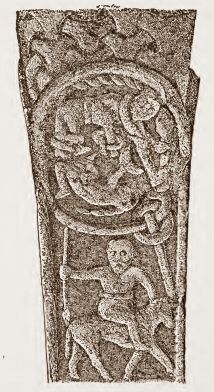
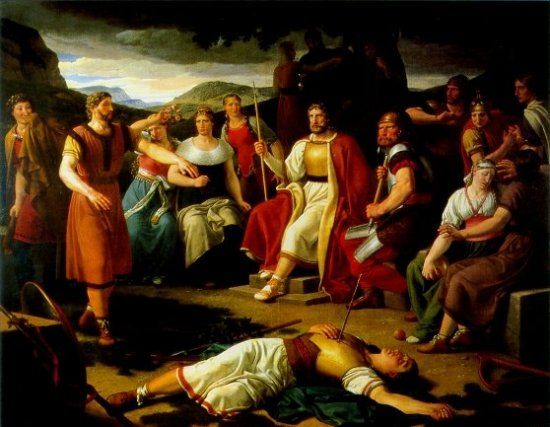
                      Of all the Norse Gods, Baldur was the finest, the wisest and the most perfect. The God of Innocence and Gentleness, Baldur the Beautiful was one of the Aesir, the Children of Odin, and lived in Breidablik, the loveliest of the Halls of Asgard, where nothing unclean could abide. But Baldur was troubled by dreams of his death so his mother, Frigg, bade everything living and dead swear an oath not to harm her son. However, of all the living things she forgot to ask the mistletoe to promise, thinking it too small and young to hurt Baldur. The rest of the Gods would amuse themselves by shooting arrows at Baldur and striking him with swords, delighting as they were magically turned aside. The God of Mischief, Loki, discovered Frigg’s omission and took a sharpened twig of mistletoe to Hoder, Baldur’s blind brother and God of Darkness, and tricked him into casting it at Baldur, who was pierced by the tiny twig and killed instantly. 

The Death of Baldur

The Aesir lamented the loss of the Beautiful God and Helmod the Nimble begged Hel, God of the Dead, to return Baldur to life. Hel replied that he would agree if every living thing would weep for the loss of Baldur but Thokk, a giantess who was really Loki in disguise, said she would weep only dry tears (which are sparks) and so Baldur remains in Hel until Ragnarok, the Twilight of the Gods, after which he will return to life. 

The Punishment of Loki

As a punishment, Loki was bound by his intestines to a rock and a serpent was placed over his head, to drip venom on his face. Loki’s loyal wife, Sigyn, caught the venom in a bowl but when she had to turn away to empty it when it was filled, the venom dripped onto Loki’s face, making him writhe in agony and thus causing earthquakes. It is because of the death of Baldur that darkness triumphs over light every day and summer gives way to winter every year. The mistletoe was punished by being banned from growing in the earth ever again. 

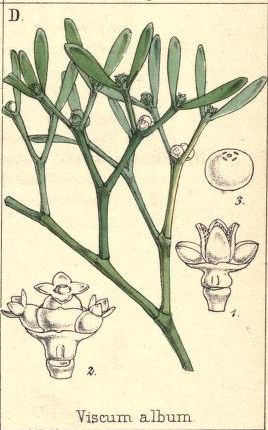
Mistletoe

In his Natural History, Pliny the Elder describes how the Druids of Britain would harvest mistletoe by cutting it from oak trees with a golden sickle and catching it as it fell in a white sheet before it touched the ground, which would remove its power. The mistletoe was known as a ‘heal all’ by the Druids but it is, in fact, poisonous and should never be eaten, as it can result in severe stomach ache, diarrhoea and gastroenteritis and in extreme cases can be fatal, although tests are being undertaken to examine its possible use in the treatment of certain cancers. When the Christians drove the Druids out of these islands, they adopted the use of mistletoe in their Christmas celebrations although some clergymen, wary of its pagan associations, would not allow mistletoe to be used in church decorations. A Cornish tradition says that the Cross on which Jesus was killed was made from mistletoe wood, which was cursed ever after to be a parasite. 

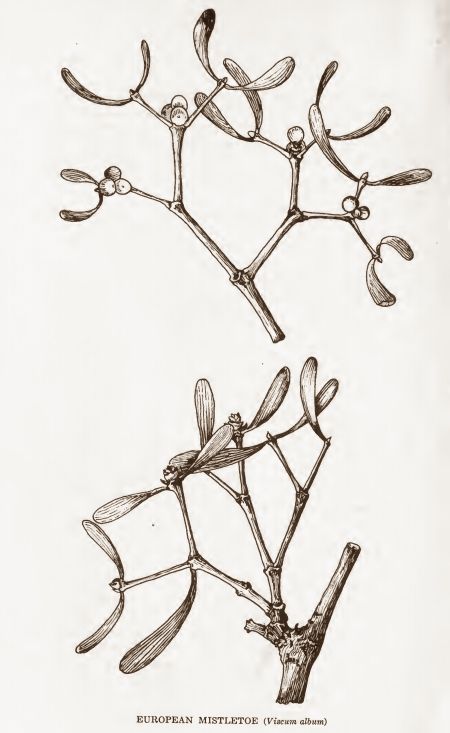
Mistletoe

Mistletoe was hung up in homes, particularly in kitchens, where the tradition of kissing beneath it developed, with a berry taken away for each kiss until none were left and there were no more kisses; if a girl did not receive a kiss under the mistletoe, she would not be married in the next year. The plant was the only decoration that would not be taken down on Twelfth Night, but remained hanging throughout the year until replaced the following Christmas Eve, and would protect the house from fire or lightning (hence the Swiss word for mistletoe - Donnerbesen). Mistletoe was also hung outside, to provide a place for the night spirits to roost peacefully. 

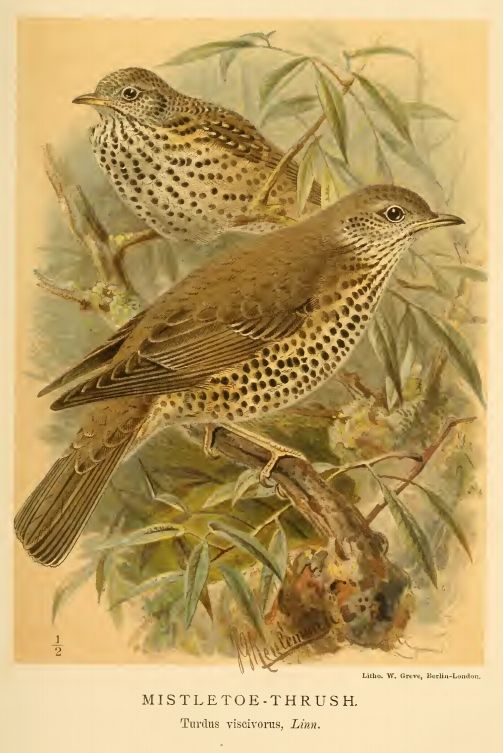
The Mistletoe Thrush

The seeds of the mistletoe are spread by birds, either in their droppings or by wiping the sticky pulp from their bills, the mistle thrush in particular being noted for this – it was once called the mistletoe thrush - and the name of the plant is derived from this behaviour. Mistletoe comes from the Germanic words mist (related to Anglo-Saxon mixen) meaning ‘dung’ and tan meaning ‘twig’.


Monday, 10 December 2012

The Fabled Folklore of the Robin Redbreast


                     There are three kinds of birds that regularly feed in my garden. There are a pair of blackbirds that come and eat the berries from the Rowan tree – they leave their droppings on the brick wall near the door. There is a wren that comes early in the morning and hops from bough to bough in the bushes. And there is the Robin, who comes and sings by the kitchen window, sitting in the Firethorn, his breast as red as its berries. 

Robin Postman

We see a lot of robins at this time of year, particularly on Christmas cards, because in the past the postmen wore red tunics and were nicknamed ‘Robins’, so they appear on the kinds in their bird form as tokens of the deliverymen. The Robin was originally called the Redbreast but as people began to add proper names to the names of animals and birds they became Robin Redbreast, later shortened simply to Robin; much the same happened with the Jenny Wren and the Jackdaw. In Lancashire there is a rhyme,
“The robin and wren
Are God's cock and hen.
The spink and the sparrow
Are the deil's bow and arrow.”
(The spink is a dialect name for the chaffinch or sometimes the yellowhammer).

Robin Redbreast

The Robin is held to be a special bird in British mythology and should never be harmed. Even when egg-collecting was a popular hobby, it was very rare for anyone to take Robin’s eggs. The reverence comes from the way in which the bird got its red breast. In some legends, it was an all-brown bird until it was touched with the blood of Christ as he hung on the Cross, in some versions singing into his ear to alleviate the agony of his final moments, in another version attempting to pluck out the nails or the thorns from the crown, and another version has the Robin trying to staunch the wound in Christ’s side made by the legionary’s lance. Another legend says that the Robin scorched its breast in the fires of Purgatory, mercifully taking drops of water in its beak for the lips of the parched souls in torment, in Wales this act has earned the bird the name of brou-rhuddyn – ‘breast-burnt’. 

The Robin

A variation of this is that the wren stole fire from heaven and returned to earth aflame, so the other birds all contributed one feather each to replaced those burnt away, but the Robin was anxious and came too close to the poor wren thus he also caught fire, the remains of the burn remains on his plumage. Yet another legends tells that if the Robin and the Wren find the unburied body of a dead person, they will work together and cover it with leaves. This act of kindness is mentioned in the old English ballad of the Babes in the Wood,
“And when they were dead.
The robins so red
Brought strawberry-leaves,
And over them spread.”

The Babes in the Wood

There is a folk legend that says if a Robin dies in your hand, that hand will always shake uncontrollably.
“‘How badly you write,' I said one day to a boy in our parish school; your hand shakes so that you can't hold the pen steady. Have you been running hard, or anything of that sort?' 'No,' replied the lad, 'it always shakes: I once had a robin die in my hand; and they say that if a robin dies in your hand, it will always shake.”
C A Federer – Notes and Queries April 4th 1868.

Notes and Queries - April 4 1868

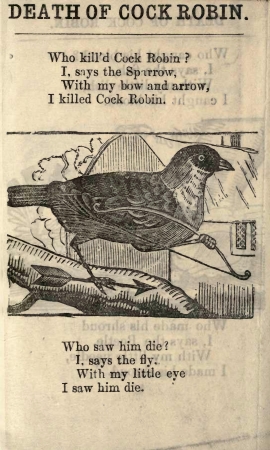
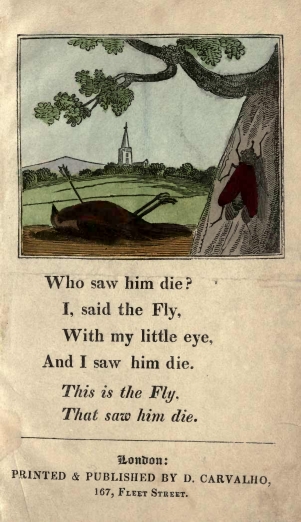
Of course, the most famous of the rhymes about the Robin must be ‘Who Killed Cock Robin’. The rhyme in print dates to about 1744 with the form familiar to use coming from about 1770, although it may be a much older tale. 

Death of Cock Robin c1860

It is a favourite nursery story and is used in early reading lessons as it follows a repeated, familiar pattern. The short verse form allows ample opportunity for illustration, giving some delightful period versions. Claims that the rhyme is an allegory for some actual historical event are unfounded and are another example of the present applying hindsight to the past.

Death of Cock Robin c. 1830


Sunday, 9 December 2012

The Nonspoken Nomenclature of the Puckish Prankster


                             It is not wise to upset some things. Apple carts, for one. Or the Kindly Ones. That’s why we call them the Kindly Ones – so as not to upset them. The Eumenides, that’s Greek for the Kindly Ones, were really the Furies, the Erinyes, but you don’t go around calling them that, not if you know what’s good for you. No, you’re respectful, you give them a nice euphemistic name and you hope that they don’t notice you. Bad things happen to you if you bring yourself to their attention, so speak softly and with a little respect. 

The Erinyes

The same is true of the Little People, or the Good Folk. You don’t go calling them by their proper name either because they just might hear you. And then they might come looking for you, just to see who is talking about them. And you don’t want that to happen, not if you can avoid it. Puck is another one. Don’t speak his name aloud. Call him something else. Call him Robin Goodfellow instead. Best be on the safe side. Just to be sure. Robin Goodfellow has a long pedigree – he may even be the Green Man, and in Reginald Scot’s A Discouerie of Witchcraft (1584) he appears amongst a great list of menacing things that our ‘mother’s maids’ have named to scare us: -  
“… bull beggers, spirits, witches, urchens, elves, hags, fairies, satyrs, pans, faunes, sylens, kit with the cansticke, tritons, centaurs, dwarfes, giants, imps, calcars, conjurors, nymphes, changlings. Incubus, Robin good-fellowe, the spoorne, the mare, the man in the oke, the hell waine, the fierdrake, the puckle, Tom thombe, hob gobblin, Tom tumbler, boneles, and such other bugs, that we are afraid of our owne shadowes.” 

William Shakespeare - A Midsummer Night's Dream - 1600

Shakespeare used Scot’s book as a reference for his plays, it’s one of the places from which he got the model for the witches in Macbeth (… or The Scottish Play, if you prefer to play it safe), and Puck appears in his A Midsummer Night’s Dream (1600), where he gets up to his merry pranks along with the other Little People. Robin Goodfellow had been around in print long before Shakespeare wrote about him, and he almost certainly had read a pamphlet entitled Robin Goodfellow, his Mad Prankes and Merry Jests, the earliest existing version of which we have now have dating from 1628 but earlier versions existed to at least 1588. 

Robin Goodfellow - His Mad Prankes and Merry Jests - 1628

A woodcut illustration on the pamphlet depicts a goatish satyr, holding a candle and a broomstick and with a hunting horn hanging about his neck and surrounded by tiny, black, dancing figures, with a black cat, a jug and Tom Thumb playing his pipe set nearby. He looks very like someone else who we don’t speak of, just in case he appears. In the verses and tales of the pamphlet are the said mischievous pranks and jests which Robin performs; blowing out candles, hiding property, pinching people, knotting their hair, souring milk and so forth. None of it is malicious and all are accompanied with Robin’s characteristic “Ho, ho, hoh,” laughter (there is a Norfolk proverb, ‘To laugh like Robin Goodfellow’). Indeed, if someone pleases Robin, he will do their drudgery for them, cleaning hearths, sweeping chimneys, sweeping floors, leaving money in their shoes, and so on; as befits his goatlike appearance, he is capricious. 

Richard Dadd - Puck

The name Robin Goodfellow also gives us many variations – Robin, a diminutive of Robert, supplies us with hob, as in hob-goblin, hob-thrush and hob-in-the-lantern. There are the Yorkshire Dobbies, revived by J K Rowling as house-elves, the Dobbins of the Midlands and there are the Lancashire Hobbils, transformed by Tolkien, who was at Stonyhurst, into the Hobbits. Robin Redbreast, of course, and Robin Goodfellow is one step away from Robin Hood, in turn one step away from the Green Man. Fellow may derive from the Greek Φαλλος through the French fallot, a lantern or candle affixed to a pole, (as seen in the woodcut of Puck), with connections to phallus and thyrsus, and maybe indicating the bright and shining humour of a wit like Robin. 

Rudyard Kipling - Puck of Pook's Hill - 1906

Perhaps the most pleasing incarnation of Robin Goodfellow appears in Puck of Pook’s Hill (1906) by Rudyard Kipling. Two children, Dan and Una, are acting out A Midsummer Night’s Dream in a meadow when Puck himself appears, telling them that he is ‘the oldest Old Thing in England’, and begins to relate tales of Old England, from Weland the Smith’s sword, a soldier on Hadrian’s Wall, a Norman who took part in the Conquest and so forth, culminating with the signing of Magna Carta. 

Rudyard Kipling - Rewards and Fairies - 1910

Kipling returned to Puck four years later, in Rewards and Fairies, which continues the story of Dan and Una one year on, when they meet Puck again and he tells them more stories of Old England, this time with a more supernatural slant. It was in Rewards and Fairies that Kipling first introduced the poem If- which has been voted the most popular poem in English. If you haven’t read Puck of Pook’s Hill or Rewards and Fairies, you really should. They are a fantastic recreation of a lost time.

Puck, Dan and Una - Kipling - Puck of Pook's Hill

Saturday, 8 December 2012

The Awful Affliction of the Fairy Fellow


Pity Poor Richard.

                                  Richard, in this case, being Richard Dadd, who was born at Chatham in 1817. In 1834, the family moved to London, where three years later Richard entered the Royal Academy School. Young Richard was an excellent draughtsman and won a series of medals for drawing at the Academy school, and began a promising career by exhibiting and selling his early paintings, many of which are now lost. Two that are still known, Titania Sleeping and Puck (both c. 1841), show his early poetic imagination and fondness for fantasy subjects, and the following year he was commissioned to illustrate Robin Goodfellow for S C Hall’s Book of British Ballads

Richard Dadd - Robin Goodfellow - Book of British Ballads - 1842

As his reputation grew, Dadd was commissioned to accompany Sir Thomas Phillips, a South Wales solicitor, on his Grand Tour of Europe, to record the sights seen (these were, remember, the days before photography). 

Richard Dadd - Robin Goodfellow - Book of British Ballads - 1842

Phillips had been mayor of Newport during the Newport Rising of 1839, the last large scale armed rebellion on the British mainland, when Chartists attacked the Westgate Hotel in an attempt to free their imprisoned colleagues. There was a violent gun battle as troops fired on the rebels and Phillips was seriously wounded when the Chartists returned fire. The rebellion was suppressed, over twenty Chartists were killed, and Phillips became a national hero, being knighted by Queen Victoria just six weeks later. 

Richard Dadd - Thomas Phillips in Arab Costume

At the somewhat advanced age of 41, he and Dadd departed on a belated Grand Tour on July 16th 1842, travelling first to Ostend and then, by rail, caliche, horse, mule, foot, steamboat, char-à-banc, vettura and rowing boat, through France and Northern Italy, Greece, Turkey, Cyprus and the Holy Land. All the while, Dadd sketched what he could of the sights and sites, recording as best he could the exotic peoples and places, but feeling that he had insufficient time to do them justice. 

Richard Dadd - The Artist's Halt in the Desert

The pace was unrelenting and the two men stayed where they found lodgings, everywhere from Maronite convents to peasant mud huts. In Egypt, Dadd was tremendously impressed by the scale and grandeur of the ancient monuments and temples, and began a fateful, life-long interest in the mythology of the Ancient Egyptians. The rigour of the tour began to tell, even on Phillips, who hired a boat with a crew of sixteen to navigate the Nile, and it was at this time that Dadd began to suffer from what was then thought to be sunstroke. On the return journey home, Dadd began to suffer from increasing periods of depression and delusions, and began to quarrel with Phillips, severely straining the relationship. Phillips thought that Dadd should seek medical help for his condition and the two parted in Paris, as Dadd returned back to London alone. 

Richard Dadd - The Temple of the Caliphs

It quickly became obvious that there was something seriously wrong with him; in his youth he had been noted for his calm, kind, considerate and affectionate nature, full of humour and mirth, but now he was gloomy and reserved, unpredictable and occasionally violent, convinced he was being watched by unknown enemies, haunted by devils, and that his actions were governed by the will of Osiris. His descent into insanity undoubtedly had an hereditary element (four of the seven children born to Dadd’s father and first wife died insane), but his condition was also worsened by the hardship of the journey in the Middle East and the things he saw there. His behaviour became more and more erratic – in his rooms at Newman St, three hundred eggs and quantities of ale were found, his only diet then being boiled eggs and ale – and his father, Robert, took him to see Dr Alexander Sutherland of St Luke’s Hospital, a leading specialist in mental illness. 

Richard Dadd - working on Contradiction; Oberon and Titania

Sutherland’s opinion was the Richard was non compos mentis and should be placed under restraint but Robert was devoted to his son and determined to care for him himself. Two or three days later, Richard asked his father to accompany him to Cobham, a favourite childhood haunt, where he promised to ‘unburden his mind’, and after resting at the Ship Inn and booking rooms in the village, they walked to Cobham Park, where near a chalk pit named Paddock Hole, at about 11 PM, Richard drew a razor and first tried to cut his father’s throat before stabbing him to death with a spring knife he had bought especially for the purpose. Richard ran away to Dover and took a ship to Calais, from where he departed for Paris, but was overpowered and detained when he attempted to cut the throat of a fellow traveller with a razor. He was detained in a French asylum before being extradited to England, where after a brief spell in Maidstone gaol, he was transferred to Bethlem Hospital. 

Bethlem Hospital

The early Bethlem hospital had, rightly, been the linguistic and factual origin of Bedlam, a chaotic hell of clamour and madness. By the 1840s, those days were long gone and a much more enlightened treatment of the mentally ill prevailed, (relatively speaking, of course). Dadd was transferred there in a straitjacket, but was never physically restrained again. He told doctors that he had killed his father because he thought he was a servant of the devil and that Osiris, his true father, had commanded him to destroy all of the infernal agents in the world. He had, he said, been told to kill the Pope and the Emperor of Austria, amongst others, and in addition to the eggs and ale found in his rooms were portraits of his friends, all depicted with their throats cut. A list of names found in his pocket had that of his father at the top. 

Richard Dadd - Portrait of a Young Man (possibly W C Hood)

From 1852, Bethlem was controlled by Dr William Charles Hood, a man of vision and compassion, who introduced larger windows to the hospital, and had each ward furnished with an aviary of singing birds, flowers, pictures, statues and books, to provide the inmates with distractions, interests and amusement. His steward, George Henry Haydon, a similarly enlightened man, assisted Hood and they encouraged Dadd’s return to painting. 

Richard Dadd - Jerusalem from the Palace of Herod

At first he worked up the sketches in his sketchbooks done on the Tour, producing Orientalist landscapes and figure paintings, but in 1854, he began the first of his remarkable fairy paintings, Contradiction; Oberon and Titania, a subject taken from A Midsummer Night’s Dream

Richard Dadd - Contradiction; Oberon and Titania

Dadd dedicated it to Hood and spent four years working on it – in the only photograph of Dadd, he is seen at work on this painting. It is, arguably, his finest work although not his most famous, which was painted for Haydon, who admired Contradiction so much that he asked Dadd to paint another fairy picture for him – The Fairy Feller’s Master-Stroke

Richard Dadd - The Fairy Feller's Master-Stroke

This is the strangest picture ever painted in England, maybe even the strangest picture ever painted anywhere. The eponymous leather-clad fairy feller lifts an axe over a hazelnut and is about to attempt to split it open with a single blow. He is surrounded by all manner of other fairy folk, some of whom look on in interest whilst others turn away in distraction. The work is painted in microscopic detail, in the manner of a miniature, jewel-like and glittering. Its power lies in its strangeness, we have no idea what is really going on and why. Something strange is happening, but we have stumbled across it and we know, deep down, that we have no place here. This is most definitely not for mortal eyes to see but we gaze in fascination, draw in by the magic, minutely scrutinising the details and always finding something new, something hidden, something secret. We do not know what will happen when that nut is cleft apart with that one fell blow but it will terrible, that much we feel in our bones. It is an utterly alien world that does not concern us, there are powers at play here that we can never hope to understand. It is, in every meaning of the word, magic. 

Richard Dadd - Sketch for The Fairy Feller's Master-Stroke

The work remains unfinished but Dadd continued to paint for the rest of his life. After twenty years at Bethlem, he was transferred to the new hospital at Broadmoor, which was much more convivial and freer, and although he remained severely mentally ill, he found a kind of peace in the surroundings there. 

Richard Dadd - Mad Jane

He had periods when he was free from the voices in his head and was lucid; he painted stage scenery for the theatre in Broadmoor, he played the violin, on which he was very skilled, read classical literature, history and poetry and was kept informed of all the new developments in the art world. 

Richard Dadd's scenery paintings at Broadmoor (now lost)

And then Osiris returned with a terrible vengeance, ordering Richard to suddenly attack his fellow inmates, to act outrageously and disagreeably, to rave and to rant incoherently. And so he remained incarcerated until, in 1885, he became seriously ill with consumption. Richard Dadd died at Broadmoor on January 8th 1886, and was buried in the little cemetery there. Pity poor Richard.

Friday, 7 December 2012

The Considerable Crimes of the Cutpurse Cross-Dresser


                                  When Mary Frith was a little girl she was described as ‘…  a very Tomrig or Rumpscuttle,’ which isn’t a description we use of little girls too often in our own day (although perhaps we should); she was, as we might say instead, a tomboy. She would run, jump, hop and fight with boys, and very often beat them, and soon developed a taste for tavern-life. Her parents had thought to put her into service but she had no love for housework and had a ‘… natural abhorrence to the tending of children.’  Instead, she grew up to be ‘a lusty and sturdy wench,’ took to a life of crime and gained notoriety as a bully, forger, receiver of stolen goods, fortune-teller and as a pick-pocket, from which she earned her nickname of ‘Moll Cutpurse.’ 

A Cutpurse

In those days (the early 1600s) before pockets became popular, people would carry their money and valuables in a purse on their belts or girdles, and a cutpurse would surreptitiously cut the strings by which it was suspended and steal it away. They worked in teams; a ‘bulk’ would create an obstruction or distraction (usually starting a fight), the ‘file’ (like Moll) would cut the purse whilst the third, the ‘rub’, would carry it off. For a £20 wager, Moll dressed in a doublet and breeches, boots with spurs and with a trumpet in her hand and a banner over her back, rode from Charing Cross to Shoreditch on Morocco, a famous performing horse. 

Morocco - the Performing Horse

Moll was hauled before an ecclesiastical court for the ‘crime’ of impropriety, (wearing men’s clothes), and was sentenced to do penance wearing a white sheet at the door of Old St Paul’s Cathedral, after which she regularly wore men’s clothes, feeling that she had paid for the licence to do so. She was said to have wept copiously as she underwent the punishment, which undoubtedly pleased the authorities, until it came out later that she had drunk six pints of wine before she went to be punished. She was also, it is said, the first woman who regularly smoked tobacco in England. 

Moll Cut-Purse Smoking

She was a fine horsewoman, an adroit fencer and fought readily with a cudgel, and contrary to the norm of her day, she appeared on stage in plays and also played the lute to an audience (when only male performers were allowed in the theatre). She also made what is considered to be a marriage of convenience in 1614, to counter allegations that she was a ‘spinster’ (which was code for ladies who, shall we say, favour the flatter shoe). 

Middleton and Dekker - The Roaring Girle - 1611

Moll was known as a ‘roaring girl’, after the ‘roarers of her day – young men who drank heavily in taverns and then fought savagely in the streets, just for the hell of it – and a play by Middleton and Dekker ‘The Roaring Girl’ (1611) was written about her exploits, presenting her in a flattering, if idealized, light. Another play, Amends for Ladies, a comedy also featuring Moll Cutpurse, by Nathaniel Field, appeared in 1639. 

Nathaniel Field - Amends for Ladies - 1639

After King Charles returned from the Scotch War in the same year, she rushed out into Fleet Street, shook and kissed the King’s hand shouting, “Welcome Home, Charles,” and paid £20 for wine to be poured down the Great Conduit which brought fresh drinking water into the city of London. When the Civil War broke out, Moll declared herself most definitely for the King, and her exploits as a highwaywoman served the Royal cause, as she only robbed Cromwell’s supporters. She was said to have robbed General Fairfax and his men of 250 Jacobuses (a golden coin worth 25 shillings), on Hounslow Heath, shot him through the leg and killed two horses belonging to his servants, was pursued and taken prisoner by the Roundheads and sent to Newgate Prison, where she gained her freedom with a bribe of £2,000. 

Moll (or Mall) Cut-Purse

She considered the robbery to be just, as the Parliamentarians had, in her opinion, stolen the crown from her King. She used the proceeds from her highway robberies to buy food and provisions for the cavalier soldiery. In later life, she became a procuress and ran a bawdy house, catering for both male and female clientele, high and low alike, and made more money by becoming a go-between that negotiated between thieves and the robbed for the safe return of stolen property. She also had trained animals, which she exhibited for profit, and can be seen with an ape, a dog and a parrot in a contemporary portrait. 

Moll Cutpurse and her animals

She died from dropsy, on July 26th 1659, aged 74, and left only £100 out of an estimated fortune of once over £3,000, having given away most of the proceeds of her crimes, much of it to distressed cavalier soldiers. She left her remaining money to a relative, John Frith, a shipmaster at Rotherhithe, advising him to spend the money on wine, like a man, rather than risk drowning in salt water, like a dog, with £20 to be set aside and spent to make wine run once more down the Fleet Street Conduit.


Middleton and Dekker - The Roaring Girle - 1611

Thursday, 6 December 2012

The Misplaced Memory of the Rosy Rings


                      Yesterday I mentioned Lord Chesterfield’s letters to his son and I’d like to begin today by quoting from one of the most familiar of those letters – Letter XXX, dated February 22nd 1748 (Old Style), which towards the end has this, 
Wear your learning, like your watch, in a private pocket: and do not pull it out and strike it; merely to show that you have one. If you are asked what o’clock it is, tell it; but do not proclaim it hourly and unasked, like the watchman.” 
Good advice, indeed. Nobody likes a clever clogs. So, now I turn to a nasty little book by Norman Cantor called In the Wake of the Plague (2001). 

Norman Cantor - In the Wake of the Plague - 2001

In this volume Cantor’s takes his learning out of his pocket and strikes it like a drunken campanologist. He is, (or was, he died in 2004), we read in the blurb, Emeritus Professor of History, Sociology and Comparative Literature at New York University and Cantor is not backward at coming forwards, letting us know about his former position as Fulbright Professor at Tel Aviv University and so forth. 

In the critical bibliography, Cantor sets about the works of previous writers about the Black Death with undisguised relish. One book is dismissed as being ‘out of date’, another is ‘verbose, unfocussed and now out of date’. The next on his list (I won’t give the titles or authors, out of respect for them), gets ‘The text could have been much better’, whereas the next is ‘puff pieces of speculative nature’ and the list continues; ‘fragmentary and superficial’, ‘almost unreadable’ and perhaps most damning of all, ‘The best part of this book is the pictures’. 

Wow, from this we’d expect Norman to be on his game in his own, as I say, nasty book (I call it that because it’s one thing to be ‘critical’ but quite something else to be so downright nasty). Right, Chapter One and I quote, 
In the England of 1500 children were singing a rhyme and playing a game called ‘Ring Around the Rosies [sic].’ When I grew up in Canada in the 1940s children holding hands in a circle still moved around and sang: Ring around the rosies, A pocketful of posies, Ashes, ashes, We all fall down. The origin of the rhyme is the flulike symptoms, skin discolouring, and mortality caused by bubonic plague. The children were reflecting society’s efforts to repress memory of the Black Death of 1348-49.” 
Let me stop you right there, Norman. As Emeritus Professor and Fulbright Professor and whatever else you’ve been, you should know the value of going back to the primary sources. Just where in England were these 1500s youngsters singing this rhyme? I only ask because the earliest sources of the rhyme date from around about 1790, with the earliest written source dating from Kate Greenaway’s 1881 book Mother Goose; or, the Old Nursery Rhymes

Kate Greenaway - Ring a Roses - from Mother Goose - 1881

The great English folklorist Alice Gomme includes a variety of versions collected throughout the English counties in her magisterial Traditional Games of England (1894) and compares them. She notes the ring of roses, speculating that the children making up the ring could stand for the rose children or sun children of pagan myth, and also notes the sneezing element that is common to them and how it changes in the American versions to ‘ashes, ashes’, and how this may be related to the many folk superstitions about the sneeze. 

Alice Gomme - Ring o' Roses - from Traditional Games - 1894

What she doesn’t do is mention either the plague or the Black Death. And neither does anyone else. This is odd if, as Cantor tells us, this rhyme has been doing the rounds since the 1340s or, to put it another way, since the days before Chaucer. Not one mention. Anywhere. Not in Chaucer, or Shakespeare, or Milton. Not in a poem, or a song, or a play. That’s a bit weird, don’t you think? 

Ring o' Roses

Indeed, the first mention of the plague theory doesn’t come until after World War II, when the idea was first put about that the Ring of Roses referred to the circular rings that appeared under the armpits of the plague victims. The pocketful of posies were the bunches of herbs carried to fend off the smell of the plague, the sneezing Atishoo, atishoo was the ‘flulike’ sneezing before the plague finished you off, and ‘all falling down’ speaks for itself. 

A Plague Doctor

Obviously. Except. With bubonic plague you don’t get rings of roses under your arm. You get buboes but these are black or purple swellings of the lymph nodes in the armpits and groin (hence the name, from the Greek βουβών - boubos meaning groin). The posies could be posies of herbs, or the herbs stuffed into the beaks of plague doctors, or wreathes placed on graves, or even a euphemism for pus (posy - pusy), oozing out of the buboes. Or something else that your fancy might like to apply to them. And sneezing? Not with bubonic plague. You might cough a lot with pneumonic plague, and you might shiver and shake a lot but not sneezing overly. And all falling down – well, it refers to the curtseying that happened in the children’s game. That’s been recorded in the past. But not falling down, as the plague would have already forced you to take to your bed before you died. It was quick but not that quick. 

Ring o' Roses

The whole plague associations are a modern invention, making something up from an existing rhyme by shoehorning a new interpretation onto it. And as with yesterday’s tale of the riots that didn’t take place, lazy historians have taken it as read, without bothering to check their sources. Lazy, if you’re an undergraduate History student, unforgivable if you’re an Emeritus Professor of History. And not in Chapter One, if you expect us to give any credence to whatever follows next.