Thursday, 7 June 2012

By the Book


                 If sets of cigarette cards can be said to be miniature encyclopaedias (see yesterday), then true encyclopaedias are another matter. The word comes from the Pseudo-Classical Greek phrase, έγκύκλιος παιδεία – enkyklios meaning ‘circular, general’ (think of ‘encircling’) and paideia meaning ‘education’ (from ‘pais’ ‘boy, child’, think of ‘paediatric’), the whole meaning ‘general knowledge’. When copyists met the phrase in the Latin texts of Quintilian, Pliny and Galen they took it to be one word and by the 16th century the noun was being used in the titles of books, (Rabelais uses the word in his Pantagruel of 1532 (Book Two, chapter XX – ‘… he hath to me discovered the very true well, fountain, and abyss of the encyclopaedia of learning’). 

Pliny Natural History Title Page

Pliny (the Elder), is generally credited with the first encyclopaedia with his 37 volume Naturalis Historia (Natural History) of 77 CE, which included twenty thousand extracts from two thousand works by more than four hundred authors of his own and previous ages, (Pliny, as I’ve mentioned before, really deserves a posting of his own). The first ‘real’ encyclopaedia in English was the Lexicon Technicum of 1704 by John Harris, which introduced the convention of arranging the entries in alphabetical order. Although it claimed to have universal scope, it was limited to mainly the physical sciences and mathematical subjects, (Isaac Newton contributed his only published work on chemistry to the 1710 edition). 

Chambers Cyclopaedia Title Page

The success of Harris’s work encouraged Ephraim Chambers to publish his two-volume Cyclopaedia (1728), which correlated the entries by an elaborate system of cross-references, for which innovation Chambers has earned the sobriquet ‘The Father of the Modern Encyclopaedia’. In about 1745, a French publisher Le Breton sought to issue a French translation of Chambers’ Cyclopaedia, but the project quickly changed from a mere translation to an original work in its own right. Overseen by Jean d’Alembert and Denis Diderot, the Encyclopédie contained entries by many of the Philosophes, including Voltaire, and was dogged by controversy from the outset. King Louis XV forbade publication in 1752 after complaints by Jesuit clergy, although the Director of Publications, Lamoignon de Malesherbes, (and the King’s mistress, Mme de Pompadour) encouraged them to disregard the ban. D’Alembert’s article on ‘Geneva’ upset the Calvinist pastors there, who sought a Europe-wide ban, and in 1757, Louis XV banned it again, following an assassination attempt by Robert-François Damiens, who was said to have been unbalanced by his exposure to liberal opinions. The 17 volume Encyclopédie was completed in 1772 (expanding eventually to 28 volumes, with supplements and books of plates), yielding an estimated profit of two million livres for the publishers, and by 1789 it is estimated that 25,000 copies, in various editions, had been produced. 

Encyclopédie Title Page

Encouraged by the controversy and the agitation caused by the Encyclopédie, three Scots from Edinburgh (the Enlightenment ‘Athens of the North’), planned their own version. Andrew Bell, Colin MacFarquhar and William Smellie published their work periodically over three years, starting in December 1768, with bound volumes costing £12 per set. They called it the Encyclopaedia Britannica. 

Encyclopaedia Britannica Title Page

A second edition followed from 1777, with Smellie replaced by James Tytler as editor, which ran to ten volumes, and a third edition was planned. A fourth edition followed in 1810, this time twenty-volumes composed of 16,033 pages and 581 engravings, selling at £36 per set, with about 4,000 sets sold. As further editions followed, the Encyclopaedia Britannica gained a reputation for literary and scholarly excellence, the 11th edition (1911) is particularly noted for its erudition. From the 1911 edition, under American supervision, the articles became shorter and more suited to general readership. In 1933, the Encyclopaedia adopted ‘continuous revision’, with updates done to a schedule. In March 2012, Encyclopaedia Britannica Inc. announced that the print edition was to end, as they concentrated on the on-line version. The final print edition (2010) has 32 volumes. 


This is my set of the 1948 edition of the Encyclopaedia Britannica, with all 24 volumes. I bought this for the unbelievable sum of £5 (yes, five pounds – for the complete set!) earlier this year, although I had to go to Ilkley to pick them up (only in England would I feel the need to mention this – it’s less than forty miles away).


Wednesday, 6 June 2012

Blooming Lovely


R J Lea Cigarettes were founded in 1866 and had two premises in Manchester, although they moved to Stockport at a later date. The firm was taken over by John Sinclair in 1937. This set of 50 cards Flowers to Grow was issued in 1913. These cards have a wonderful period look, although they are a bit battered. The rounded corners are an added touch.


Another set by R J Lea, this time from 1924, was the Roses set, issued in Chairman Juniors cigarette packets. Another set of 50 cards. Again, the period look adds to the appeal of this card, as does the detail on the reverse – send in 200 inserts from the cigarette packets to receive a pair of rose garden prints. Another push for brand loyalty.


Also from 1924 is this set of 25 cards, Old Favourites from Godfrey Phillips, London. Godfrey Phillips was founded in 1844 by an eighteen year old and was one of the first companies to issue cigarette cards, including enormous sets of footballer cards in the 1920s. The background landscape detail adds a nice touch to the cards.


Another set also called Old Favourites is the card on the left, from a set of 25 issued by Abdullah and Co in 1936. Abdullah were founded in London in 1902, and moved into premises in Mayfair in 1917 (in the former Fabergé shop). In 1927, Abdullah and Co was bought by Godfrey Phillips, which continued to sell cigarettes under the Abdullah brand name.


On the right is a card from CWS (Co-Operative Wholesale Society), 1924, a rarer card from a set of 24 of English Roses. The Co-Operative Wholesale Society, or the Co-Op as it is popularly known, originated from the principles established by the Rochdale Pioneers, in Toad Lane, Rochdale, Lancashire in 1844. The original Pioneers were 30 workers who struggled to raise one pound capital each, which was invested in food items – butter, flour, sugar, oatmeal and so on – and sold at affordable prices to the local community. The Co-Op soon moved into selling tea and coffee too, with other items following, and although it may seem strange today, considering the ‘ethical’ nature of the Co-Op movement, this included cigarettes.


One of the most aesthetically pleasing sets is this Gallagher’s Wild Flowers set from 1939. The pastel three-quarter borders on each card, and the background landscapes behind the flowers are particularly delightful. The complete set is 48 cards and is a slightly different shape than the usual cigarette card. A set of these cards in mint condition sells for between £30 to £40 today.


The majority of these cards are partial sets or individual cards. None of them are particularly valuable but that isn’t really the point. I’ve picked them up along the way because I like them. If you want to start collecting cigarette cards, W D & H O Wills and Players cards can still be bought, in complete sets, for a few pounds – some for less than £5.


Tuesday, 5 June 2012

It's on the Cards.


                Victor Hugo’s romantic drama Hernani debuted in Paris on February 25th 1830, and initiated a fashion for all things Spanish in France. The Spanish Dons grew the rare and valuable tobacco plants from the New World on their estates, and took great pride in offering their guests gifts made from the rolled leaves of the plants, saying, ”Es de mi cigarral” – ‘It is from my garden’. The diminutive form of ‘little garden’ – ‘cigarro’ - was itself diminished to ‘cigar’, and diminished further by the French to ‘cigarette’. 

The fashion for cigarettes spread first into France, and later, due to the Crimean War, (when soldiers from other nations came into contact with each other), across the rest of Europe. British officers and soldiers brought the habit of taking their tobacco in short paper tubes back from the war with them, and by the 1850s could buy manufactured cigarettes. The early paper packets they were sold in were unsatisfactory; the cigarettes dried out quickly and the tobacco shook out of the paper tubes. Foil inserts went some way to preventing this, and the addition of cardboard ‘stiffeners’ gave the packets an improved sturdiness. 

In the 1880s, some American manufacturers started to print advertisements on the stiffeners, and with the aim of causing their customers to retain these advertisements, more attractive forms evolved. The practice spread to the UK, and in 1895 W D & H O Will’s issued the first complete set of cards “Ships and Soldiers”. Other sets, by other firms, followed, and the cigarette card became collectable. Will’s 1897 set “Kings and Queens” was the first set to have a printed description of the subject on the reverse side. During the early 1900s, hundreds of sets were issued by over 300 companies, on a startling array of subjects – from Cricketers to Clowns, Railway Architecture to Old Sundials. 


Front of card

Reverse of the same card

This is my oldest individual card – from Player’s British Empire series of 1904.  

Cigarette companies also began to sell albums, in which the sets of cards could be kept, while the collecting of sets encouraged brand loyalty. 

Front of an album

Inside the album, showing how the cards are mounted.

This set is W D & H O Will’s English Period Costumes from 1929. 

Small boys would scrounge cards from customers as they came out of tobacconists’ shops, and swap them to make up full sets, creating a childhood currency of their own. Wartime restrictions on materials ceased production in 1917, but cards started to be issued again by 1922, and the ‘Golden Age’ of the cigarette card began. 


Here are both sets (of 25 cards each) of W D & H O Will’s Cinema Stars (1923). 

The sets from this era, especially those from Will’s and Player’s, were magnificent miniature encyclopaedias, providing informative illustrated guides to all manner of subjects in just 50 small cards. 


This is the 1923 set of Gardening Hints by W D & H O Will’s. 

Corporal Hitler’s Unpleasantness stopped production again in the 1940s, and the high costs of post-war production prevented the widespread resurgence of cards, although trade cards – in tea, cereal 0r chewing gum packets, for instance - became popular. 

The sheer volume of cards that were issued means that full sets from the 1930s and 40s can still be bought for a few pounds, although rarer sets (and individual cards) can cost hundreds or thousands of pounds – the world record is over one and a half million pounds for a single baseball card. 

 
The Do You Know? set from 1924, by W D & H O Will’s.

Monday, 4 June 2012

Don't Let the Truth Stand in the Way of a Good Story


Title Page Bligh's Voyage to the South Sea

                      William Bligh’s A Narrative of a Voyage to the South Sea (1792) is a first-hand version of the events from one of the leading protagonists. It is a fascinating read and offers valuable insights into Bligh’s thinking, character and motivations. He comes across very much as a man of his age – dedicated, professional and passionately devoted to his mission. Trained in the Royal Navy from the age of seven, he is not one to suffer fools gladly, and his frustrations when faced with lesser men are painfully evident, although his humanity, particularly his concern for the well-being of the sailors serving under him, is unmistakeable. He really seems to have wanted to avoid unnecessary hardships, particularly floggings and is genuinely upset when he has to resort to them. 

The master of the Bounty, Fryer, forces the first flogging on him; on March 10th 1788 Bligh logged, “Untll this afternoon I had hopes I could have performed the Voyage without punishment to any One, but I found it necessary to punish Mathew Quintal with 2 dozen lashes for Insolence and Contempt.” Two dozen lashes is, by the standards of the time, a lenient sentence. Capt. Edward Edwards, of the Pandora, had two men flogged 250 times each. Captain Curtis of the Brunswick (the ship on which the three Bounty mutineers were eventually hanged) had men flogged for going ashore without permission; in the three-and-a-half weeks of the courts-martial, Curtis ordered 278 lashes to be administered – Bligh ordered 229 in the seventeen months of the voyage to the South Seas. Bligh, it seems, preferred to give miscreants a tongue-lashing rather than one from the end of a rope. (David Hannay, in Blackwood’s Magazine, April 1910, calls him a ‘nagger’ [p.501].) It seems, in the various re-telling of events that Bligh, Edwards and Curtis have become conflated.

Title Page Barrow's Mutiny
Title Page of my Folio Society edition of Barrow's Mutiny

Sir John Barrow (known to all as ‘Mr Barrow of the Admiralty’) published (anonymously, at first) The Eventful History of the Mutiny and Piratical Seizure of HMS Bounty in 1831. It is still in print today. Barrow uses Bligh’s Voyage as a primary source and adds further information about the voyage of the Pandora and the settlement on Pitcairn. He had access to the papers of the (by then) late Thomas Heywood and appears to be at pains to present Heywood in the best possible light, (tarring Bligh in the process).

Title Page Aleck

An anonymous work Aleck appeared in 1855, telling the story again, but adding more information about John Adams (by then going by his birth name Alexander Smith) and his life on Pitcairn. It goes into great detail of the life of the islanders and their adherence to the Bible, (the title page describes the book as a ‘remarkable Illustration of the Influence of the Bible’), and in the conclusion of the book the blame for the mutiny is variously blamed on the drinking of ‘grog’ and intemperate language - 

“Had Captain Bligh, instead of abusing his men, by calling them scoundrels and rascals, and threatening to make them jump overboard, used dignified language, and maintained his authority by such a deportment as would have commanded the respect of the crew, the mutiny would probably not have occurred.”

Page from McGilchrist's The Mutineers

A poem of 1859, The Mutineers, by John McGilchrist M.D. brings more blame onto Bligh’s part in the proceedings. It is not, it must be said, the finest poetry ever to have been written. Here, (with apologies to those of delicate sensibilities), is Doctor McGilchrist’s assessment of Lieutenant Bligh –

His frown was dreaded by his brawny crew
More than the gathering of the huricane,
And his fierce wrath was their worst gale that blew;
They hated him and feared him to a man.
But, although stern and cruel, he was brave.
And skilled, when danger came, the ship to save;
Hence those who hated him despised him not:
His sailors were his slaves, his ship a "hell-afloat." [Verse 18]


Title Page Lady Belcher's Mutineers of the Bounty

Lady Diana Belcher published the Mutineers of the Bounty and their Descendants in Pitcairn and Norfolk Islands in 1870, and in her preface she praises Barrow’s book, but adds that it “… did not contain all the information which might have been afforded,” as she had access to other documents. This is hardly surprising as she was the stepdaughter of Thomas Heywood, and was also married to Sir Edward Belcher, who had, on HMS Blossom, visited Pitcairn in 1825. Diana was, like Barrow, keen to present her adoptive father as favourably as possible. It was to her misfortune that she was also married to Sir Edward Belcher, the most hated officer in the Royal Navy, of whom even the normally reserved Dictionary of National Biography says, “Perhaps no officer of equal ability has ever succeeded in inspiring so much personal dislike.” On Pitcairn, in 1825, Belcher had interviewed John Adams, the last of the Bounty survivors, and had learned from him that Heywood, then but a tattooed sixteen-year-old, had not been held against his will below decks during the mutiny, but had been on the gangway ‘… and might have gone [with Bligh] if he pleased’. Thomas Heywood, it seems, had perjured himself at his court-martial, and although convicted but later pardoned, other men of lower rank and standing than him had been hanged. Lady Belcher wrote in her account of the mutiny that “… Churchill said he ‘ … had kept Mr. Stewart and Mr. Heywood below, to prevent their going with Lieutenant Bligh in the launch,’”; her husband had been told otherwise. Part Two of her book tells how John Adams (aka Alexander Smith), had learned to read and write from Christian’s Bible and prayer book, and how, when the rest of the mutineers had been murdered, Adams had turned to Christianity and led the women and children into a life of Christian piety, and how the later missionaries had fared there.

Title Page The Mutineer

The Mutineer – A Romance of Pitcairn Island, co-authored by Louis Becke and Walter Jeffery (1898), again finds Bligh to be at fault. He ‘flushes red’, he ‘sneers contemptuously’ and acts imperiously ‘as was his way’. It completes the picture of Bligh as martinet, harsh and uncaring, proud, stubborn and inflexible.

The first known cinematic version of the story was the joint Australian-New Zealand The Mutiny of the Bounty, a silent film directed by Raymond Longford in 1916 and now lost. The film was the costliest made in Australia up to that date, and attempts were made to be as historically accurate as possible.

Rare still from Longford's Mutiny on the Bounty

In 1932, two former WWI pilots Charles Nordoff and James Hall co-authored the novel Mutiny on the Bounty, a fictitious first-person narrative based on the experiences of real-life mutineer Thomas Heywood, which presents Bligh as a cruel martinet and Christian as a square-jawed hero, more sinned against than sinner.

Cover Mutiny on the Bounty - Nordoff/Hall

In 1933, came In the Wake of the Bounty, notable for being Errol Flynn’s screen debut (playing Fletcher Christian). It was director Charles Chauvel’s first talkie and, frankly, it shows. The film mixes dramatic scenes with documentary footage; the dialogue is stilted and awkward and the sets amateurish in the extreme. Bligh (Mayne Lynton) is a sneering, snuff-sniffing ‘swine’, liberally handing out lashings to his scurvy sea-dogs, whilst a Byronic Flynn smoulders aristocratically in the background. You can watch the film for yourself here : -


Errol Flynn smoulders

In 1935, Hollywood got its hands on the story. Based on the Nordoff/Hall novel, Mutiny on the Bounty starred Charles Laughton as Bligh and Clark Gable as Christian. Laughton mugs and croaks like a toad in a naval uniform, Gable smoulders Byronically in the foreground, and historical facts look on from the sidelines. Bligh has a dead man flogged (!) and another keelhauled (didn’t happen in the Royal Navy), men are shot dead in what was actually a bloodless mutiny, Christian miraculously becomes a father during the five months the Bounty spends loading breadfruit trees in Tahiti, and Bligh (not Capt. Edwards) commands the Pandora during the round-up of the mutineers. The film, somehow, won the Oscar for that year’s Best Picture.

Clark Gable smouldering

1962 gave Marlon Brando the opportunity to smoulder aristocratically in an imaginatively titled remake Mutiny on the Bounty. Unfortunately, he flounces about in Liberace’s cast-offs, and borrows an English accent from Dick van Dyke. Trevor Howard’s Bligh is an alumnus of The Captain Hook Naval Academy of Villainy, what with all his sneering, lashing, etc. etc.


'Smouldering' Marlon Brando

In 1984’s The Bounty, it’s Mel Gibson’s turn to smoulder, which he does aristocratically. Anthony Hopkins’ Bligh blusters and bawls but, amazingly, it sticks largely to the facts. Director Roger Donaldson does a good job, aided by an intelligent screenplay from Robert Bolt, and the leading actors present their characters as complex individuals, rather than the black and white caricatures of earlier versions. It’s not a bad film at all, in spite of the few faults that niggle the purist.


Mel 'Smoulding' Gibson

The Bounty by Caroline Alexander was published in 2003. Sub-titled The True Story of the Mutiny on the Bounty, this is maybe the best book on the subject written to date. It is intelligent, presents many facets from different angles, and, importantly, is very readable. If you only read one book about the Bounty, this is the one I’d recommend. It goes a great way to rehabilitating Bligh, not entirely faultless but neither entirely at fault, and gives us Christian as less Byronic hero and more moon-struck twenty-two-year-old, dazzled by dusky Tahitian beauties, and with a youthful pride all too easily wounded by Bligh’s acid tongue. 


In September 2004, the trial began of seven Pitcairn men on 55 charges relating to sexual offences with young Pitcairn girls. Six were found guilty on 35 of the charges, and four were sentenced to between two to six years in prison. In 2005, another six men, living abroad, were tried on 41 charges in New Zealand.


Sunday, 3 June 2012

Loose Ends


HMS Royal William
       
             With all the loyalists back in England, the court-martial of Lieutenant William Bligh began onboard the Royal William at Spithead, on October 22nd 1790, its aim to ascertain if Bligh and the ship’s officers had resisted sufficiently to prevent the Bounty being taken by the mutineers, not least because nineteen men had been overcome by twenty-five others. The officers corroborated each other’s stories, and, with the exception of William Purcell, the quarrelsome carpenter, Bligh avowed he had not either ‘objection or complaint’ against any man or officer. The court deliberated on the testimonies given, and concluded that the Bounty had, indeed, been ‘violently and forceably taken’ by ‘Fletcher Christian and certain other mutineers’ and Bligh, the officers and loyal men were ‘honourably acquitted’. Purcell, it was decided, was ‘adjudged to be reprimanded’. 

HMS Providence at Tahiti

In April 1791, the newly-promoted Captain Bligh was told of a second mission to transport breadfruit from Tahiti to the West Indies, and in August the three-decked Frigate Providence, with the brig Assistant, together with the requisite complement of lieutenants, officers and a company of twenty marines departed, under his command. They would sail via the Cape of Good Hope, not Cape Horn. They arrived at Tahiti in April 1792, loaded their plants, and left for the Indies, arriving at St Vincent in January 1793. Breadfruit plants were delivered to St Vincent and Jamaica, and some were brought back to London, for Sir Joseph Banks and the Gardens at Kew. On August 7th 1793, Bligh arrived back at Deptford, and home, to great acclaim.

Route of the Bounty and her launch

Two days before the start of the mutineers’ trail, Captain Edward Edwards stood before the same judges on board the Hector, charged with losing the Pandora. His officer’s swore to the veracity of their Captain’s account of events and all concerned were honourably acquitted.

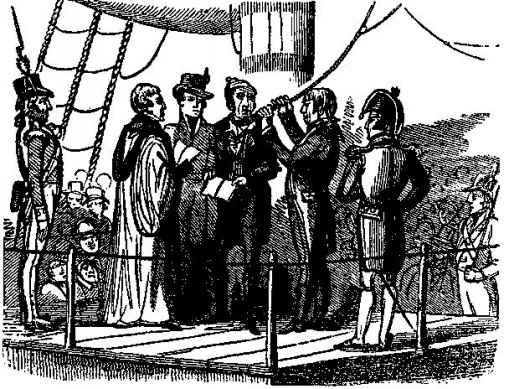
The court-martial of the men brought back from Tahiti on HMS Pandora was convened on September 12th 1792, on the Duke. The ten men were rowed from their confinement on the Hector and brought before the Judge Advocate Greetham and his court. Evidence was given, witnesses were called, defences were presented and, on September 18th, twelve post-captains deliberated before declaring that the loyalists identified by Bligh in his log, Charles Norman, Thomas McIntosh, Joseph Coleman and Michael Byrn, were to be acquitted and released immediately. The charges against the remaining six men were found proved, and they were sentenced to death, although, in ‘consideration of various Circumstances’ Peter Heywood and James Morrison were recommended to His Majesty’s Mercy, and spared. William Muspratt appealed, on a technicality, and was ultimately pardoned in February 1793. The three remaining men, John Millward, Thomas Burkett and Thomas Ellison were transferred to the Brunswick and, at 11.26 on the morning of Monday October 29th 1792, they were hanged from the yardarms.

Hanging from the yardarm

The slaves, for whom the breadfruits were destined as a cheap and nutritious food, did not take to them and refused to eat them. After all that.


Saturday, 2 June 2012

Thinking Outside the Box


                   The story of the Mutiny on the Bounty has yet more twists and turns. When Lieutenant William Bligh reached the Admiralty in March 1790, the Royal Navy was gearing up for an expected war with Spain. Warships mothballed after the Seven Years War were being brought back into service in expectation of a future conflict. Furthermore, revolution had broken out in France in July of the previous year and there were fears it may well spread elsewhere in Europe, including Britain. On the other hand, the outrageous acts of seizing one of His Majesty’s ships by armed mutiny, and setting a British naval officer adrift in an open boat in the middle of the Pacific Ocean demanded appropriate responses. 

The First Lord of the Admiralty. John Pitt, (son of Pitt the Elder), sent Captain Edward Edwards to Portsmouth to take command of HMS Pandora, a Porcupine class Frigate (well, not technically a frigate, but let’s just look the other way), armed with twenty six-pounders and four eighteen-pounder carronades, and crewed with 134 men, including a newly promoted third lieutenant Thomas Hayward, who had served as a midshipman on the Bounty and had survived the journey in the launch with Bligh. Captain Edwards had himself survived a near mutiny in 1782, whilst commanding HMS Narcissus, which had resulted in the leader of the mutiny being hanged in chains, five more men hanged, fourteen more flogged, two of whom died, two sentenced to 250 lashes each. 

Title Page Voyage of HMS Pandora by Edwards

The Pandora departed Portsmouth on November 7th 1790, with orders to hunt down the Bounty mutineers. She rounded Cape Horn without difficulty, and reached Tahiti on March 23rd 1791. Immediately, before she had even dropped anchor, Joseph Coleman, the Bounty’s armourer who had dived from the ship to escape the mutineers, came to Pandora and presented himself. He told how Charles Churchill, the ‘most murderous’ of the mutineers had himself been murdered by Mathew Thompson, who, in turn, had been killed by Churchill’s taios. Another loyalist, Peter Heywood, on hearing Thomas Hayward was on the Pandora, also presented himself voluntarily, and like Coleman, to his surprise, was deemed to be a ‘Piratical Villain’ and the pair were clapped in irons. On the second day, former able seaman Richard Skinner was also taken. Edwards learned the mutineers had built a small 30-foot schooner, which they had called Resolution, and had sailed to the south of the island, unaware of his arrival. He set off in pursuit, and on March 29th three more fugitives, and the schooner, were captured. Over the next couple of weeks, Edwards and his crew rounded up, in ones and twos, the remaining mutineers. 

Pandora with Resolution in tow

On the Pandora, Edwards had a special prison built at the rear of the quarterdeck; at eleven–by-eighteen feet, with an eighteen-inch square trapdoor on the top, the fourteen prisoners were handcuffed and shackled and forced into what they called ‘Pandora’s Box’. They were guarded, round-the-clock, by armed men. Their friends and families surrounded the Pandora, standing in their canoes, weeping and wailing, cutting themselves with sharp shells, and tearing their clothes, and watched helplessly as the frigate, with the schooner Resolution in tow, left Tahiti on May 8th 1791. Edwards was now determined to recover the Bounty and the remnants of her crew. He could not have known he had missed Pitcairn on his outward voyage, (after all, it was wrongly charted), but his orders were to search the islands of Whytootackee and the Friendly Islands to the west. For three months he moved from island to island, but no leads emerged. There were rumours, but all proved to be dead ends. Morale began to fail, two boats with fourteen men were lost, and at Anamooka a landing party was attacked. By August, with the monsoon season approaching, Edwards decided to return home. 

HMS Pandora sinking

He set course for the Torres Strait, (then called the Endeavour Strait), between Papua and New Holland. He arrived at the Great Barrier Reef, and set about looking for a passage through, sending out a yawl to take soundings. Despite all precautions, on August 29th, Pandora struck the reef, tearing a hole in the side, and began to take on water, “In 5 minutes after there was 4 feet of water in the hold”, Edwards noted. It was obvious she was sinking, and she was abandoned. In Pandora’s Box, still handcuffed and shackled, the Bounty men pleaded to be released. Coleman, McIntosh and Nelson, all identified by Bligh as innocent, were released to aid with the pumps. The eighteen-inch scuttle on the Box was bolted shut again. At dawn on the next day, Pandora’s armourer, Joseph Hodges went into the Box, and began to strike off the fetters, and the prisoners began to escape, until someone unknown again closed the bolt. Hodges continued to work, until the Pandora rolled to port and more water was taken on. Boatswain’s mate, William Moulter, drew back the bolt as he abandoned ship, and more prisoners came out of Pandora’s Box. Boats took up survivors and mustered on a sand bar, some three miles away. Thirty-one of the ship’s crew had been drowned, together with four of the prisoners. 

The Wreck of the Pandora

No one, it seems, had had the foresight to salvage provisions, although the Pandora had taken all night to sink, and with scant rations Captain Edwards and the survivors departed in a pinnace, two yawls and a launch, across the Timor Sea, bound, with cruel irony, for Coupang, the very destination for which William Bligh had navigated in the Bounty’s launch. Poor Thomas Hayward was undertaking his second open-boat ordeal in two years, undergoing the same starvation and privations, in the same South Seas, bound for the same place once again. 

HMS Pandora foundering

Blistered by the sun, and reduced to drinking the blood of seabirds or their own urine, the men crossed the eleven hundred miles in sixteen days, and astonishingly, on arrival at Coupang, the ten Bounty men were taken to the Dutch fort and put in the stocks. A Dutch officer later took pity and had them transferred into shackles. After a period of recovery, Edwards led his sorry company onto the Rembang, a Dutch East Indiaman, bound for Batavia, on Java. Six days out, off the coast of Flores, a great storm struck, shivering the sails to shreds in minutes. The Dutch crew fled below decks, so Edwards took charge and the English crew brought the Rembang to safety, although the prisoners, freed from their bonds for the work, were too weak to man the pumps. 

The Route of the Pandora

They made it eventually to Batavia, a pestilential port surrounded by filthy swamps, were malaria raged. Fifteen men from the Pandora died from disease there, the rest departed for home seven weeks later, divided on various Dutch vessels. Edwards and the Bounty men boarded the Vreedenburg, and on arrival at Table Bay, Cape of Good Hope, they transferred to HMS Gorgon, departing for England on April 5th 1791. The Gorgon dropped anchor off Spithead, Portsmouth, on June 19th and the ten mutineers from the Bounty were moved, in chains, to the Hector, awaiting court martial. Captain Edward Edwards, like Lieutenant Bligh, would go before a court martial, for also losing his ship.

Friday, 1 June 2012

Meanwhile, Back on the Bounty


                             Of the twenty-five men left aboard the Bounty, four of them were in an odd situation. The two carpenter’s mates Charles Norman and Thomas McIntosh, armourer Joseph Coleman, and able seaman Michael Byrn, had been loyal to Lieutenant Bligh, but there had not been room for them in the 23-foot launch when it was set adrift, so they had had to stay aboard with the mutineers. As it drifted away, Bligh had called to them from the launch – “Fear not, my lads; I’ll do you justice if I ever reach England,” but this can only have been scant comfort. 

The Bounty
 
The breadfruit plants, the cause of the mission, were thrown overboard, the belongings of those on the launch were divided among the mutineers, and under Fletcher Christian’s command, the Bounty turned and sailed to the east, landing at the island of Tubuai, some 350 miles south of Tahiti, on May 24th 1789. There ensued quarrels among the men, largely about women, and the islanders were opposed to the intruders, so a week later the Bounty was again at sea, heading north for friendlier reception at Tahiti. The mutineers devised the lie that Bligh had met Captain Cook at Whytootakee Island, that a settlement was planned there, and that the Bounty had been sent back for provisions, (Cook had, in fact, been murdered at Hawaii, ten years earlier). The Tahitians, who regarded Cook with almost divine veneration, were delighted that he was to settle so near to them and generously re-provisioned the Bounty with food, plants and water, and nine women, eight men, seven boys and a little girl also went aboard (some hiding until the ship was underway). 

The Bounty left, again bound for Tubuai, and for three months the mutineers tried to build a fort (patriotically called Fort George, for the King), moving the four four-pounders and the ten swivel guns ashore from the ship and into their settlement. More fights followed, there were drunken brawls, and a second mutiny threatened to break out. The Tubuaians also fought with them, and in one encounter sixty-six islanders (including six women) were killed by the Bounty men. The situation could not last, so in September they departed, again back to Tahiti.  Here they divided into two factions, fifteen electing to remain, the other ten departed on the Bounty with Christian, although the loyalist Joseph Coleman, again detained against his wishes, dived overboard and swam to shore as the Bounty left. The sixteen settlers moved in with their taios or built homes of their own, married and started families. 

On the night of September 21st 1789, the men on the Bounty cut the anchor rope and slipped secretly away, carrying nine mutineers, six Tahitian men, eleven women and a baby (some of whom may have been kidnapped). They were looking for islands to the east, said to have been discovered by the Spanish, but could not find them. Instead, they sighted Pitcairn Island, spotted first by the British sloop HMS Swallow in 1767, named after the fifteen year old Midshipman Robert Pitcairn, who had been first to see it, but incorrectly charted by 3o of longitude, (in 1773, Cook had been unable to find the island due to this error). The Bounty was deliberately run aground, set alight, and then broken up. 

Landing on Pitcairn

The island was rich in food and fertile, and farms were established, the settlers building cottages for their wives and families. In the next two years, one mutineer died from sickness and another, suffering from madness, jumped from a cliff. With an almost sickening inevitability, the remaining seven Bounty men argued with the Tahitian men (or ‘Blacks’, as they referred to them), and one night six were murdered by them, leaving only Alexander Smith surviving. The widows of the murdered men revenged themselves by killing all the Tahitian men, and Smith lived with them and the children thereafter. In 1808, a passing American sealer, the Topaz, saw land not marked on the charts, and sent out a boat party. They were met, Tahitian style, by three men in a canoe, bearing gifts of food, who guided them through the surf and onto shore. 

The house of John Adams on Pitcairn

Here, the boat party, led by Captain Mayhew Folger, found thirty-five inhabitants on the island, mostly women and children. Of the young men, all of whom spoke English, one was introduced as Thursday October Christian, son of Fletcher. Reluctantly, Alexander Smith was introduced to the men of the Topaz, who told them his story. Asked by Folger if he minded that his discovery was reported, he replied, “… he did not care for all the Navy of England cou’d not find him.” Folger eventually did make a report, which in turn, made its way back to the Admiralty, but there was little interest, for in 1814, two British ships, the Briton and the Tagus, ignorant of the Topaz’s report, also found the island unmarked on their charts. Captains Staines and Pipon were welcomed ashore, and again Smith was introduced, although he revealed his true name, John Adams, to them. He had used a false name, Alexander Smith, whilst on the Bounty, and although he did explain why, he now reverted to his birth name. 

Portrait of John Adams

Now properly marked on charts, Pitcairn was regularly visited by ships, bringing welcome goods and provisions, and a meeting with the island ‘patriarch’ (although then only in his fifties) became a necessary requirement. He died in March 1829, forty years after the mutiny. There is still a population of about 48 people on Pitcairn Island.